Idea work
A good idea found online should not go straight into the pile. It helps to look at it through a structure first.
The article is not the idea yet
A lot of useful thinking starts with an article. Someone writes something sharp, strange, irritating, or half-true, and it catches my attention. The temptation is to save the link and call that research.
But a saved link is not an idea. It is only a place where an idea appeared. If I only collect the article, then the article keeps the shape of the thought. My own thinking stays attached to somebody else's page.
The better move is to extract the idea from the article and give it a local home. That can be a wiki article: one page for the concept, with a short explanation, source links, related ideas, objections, examples, and open questions.
The link is where the idea was found. The wiki page is where the idea becomes available for reuse.
A wiki page gives the idea memory
The wiki article is not meant to be a perfect encyclopedia entry. It is a working surface. It says: this is the thing I think I found, this is where it came from, this is what it seems connected to, and this is what I still do not understand.
That already improves the idea. It separates the original author's frame from my own. It lets the same idea show up in another context later. It also gives an LLM something better than a raw article to work with.
Instead of asking the model to summarize one source, I can ask it to reason with a small local concept page. The page contains the article, but it is not trapped inside the article.
Then try a structure
After the wiki page exists, I do not want to throw it at a blank prompt. I want to press on it from a known angle.
For example: name the game. If an article is really about a system, an incentive, a habit, or a social pattern, I want these questions in front of me.
“What do you think about this?” is too easy for a model. It can answer that without looking very hard. These questions are harder to dodge. They drag the answer toward rules, winners, incentives, and formation.
The article may be about an app, a diet, a classroom, a feed, a workplace. Underneath, I am asking the same thing: what is this training me to become?
What the model can do here
The model does not need to have an opinion. I need it to hold the wiki page and the frame together long enough to turn the idea around.
Without the frame, I usually get a smooth essay-shaped answer. With the frame, the model has to handle the material. Who benefits here? What is rewarded? What kind of person gets made if I play along?
That output is still not the answer. It is worked material. I can argue with it, cut it up, link it to other notes, or throw it away.
From reading to reusable thinking
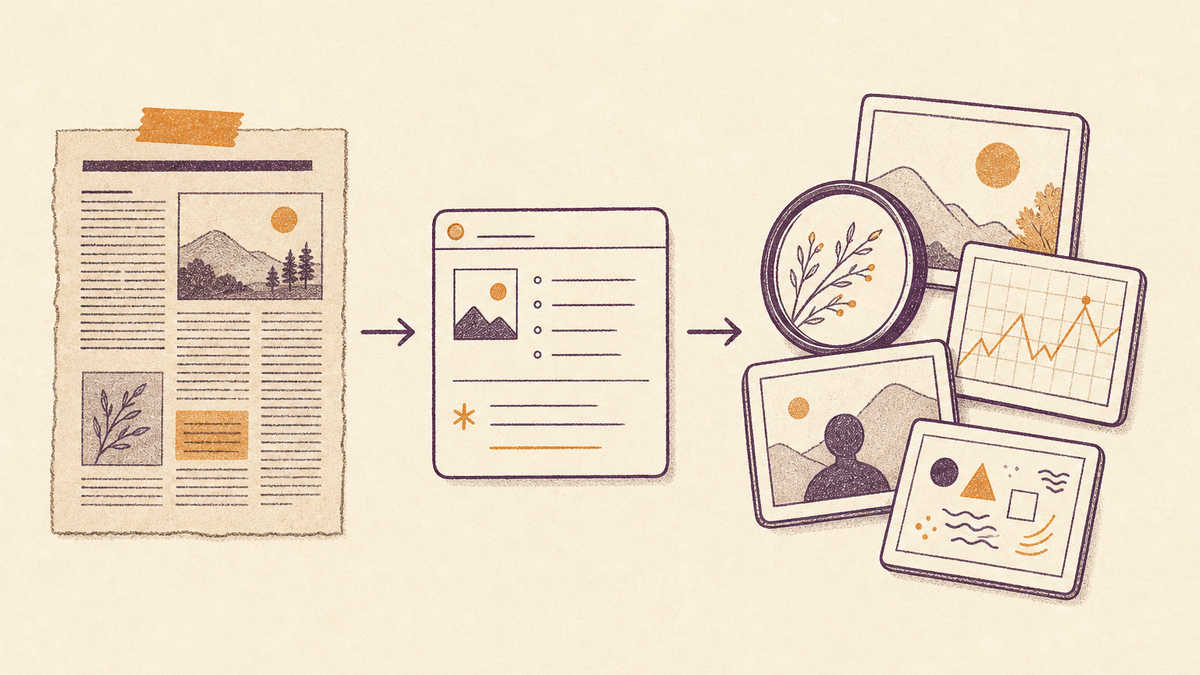
The loop is small: find an article, extract the idea, create a wiki page, pick a frame, then ask the model to work inside that frame.
What I like about this is that it turns reading into reusable thinking. The article is still there. The source is still credited. But the important part is no longer hidden inside a browser tab or bookmark list.
The idea now has a place to live, a structure to pass through, and a way to become useful in the next conversation.